The Evolution of Market Analysis
For decades, market participants have debated one question:
Should investment decisions be based on technical analysis or fundamental analysis?
Technical analysts focus on price.
Fundamental analysts focus on business quality.
Macro investors focus on the economy.
Quantitative analysts focus on data.
The reality is that successful market participants rarely rely on only one approach.
Today's markets demand a broader perspective.
The Limitation of Looking at Only One Piece of the Puzzle
A technically strong stock may fail because the sector is weakening.
A fundamentally strong company may underperform during adverse macroeconomic conditions.
A positive news event may already be priced into the market.
Looking at a single indicator often provides an incomplete picture.
Markets are interconnected systems where multiple factors influence outcomes simultaneously.
What Is Techno-Fundamental Research?
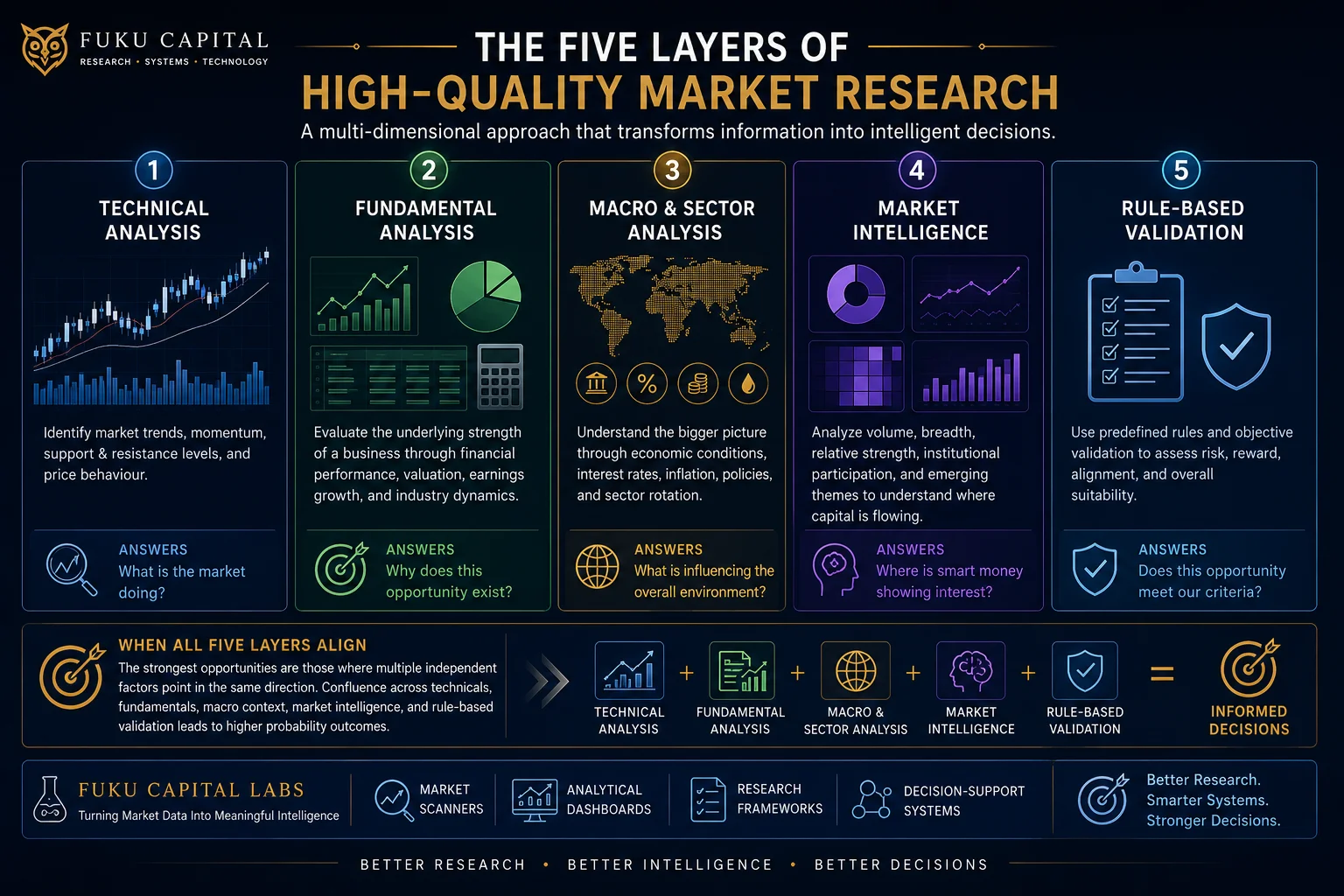
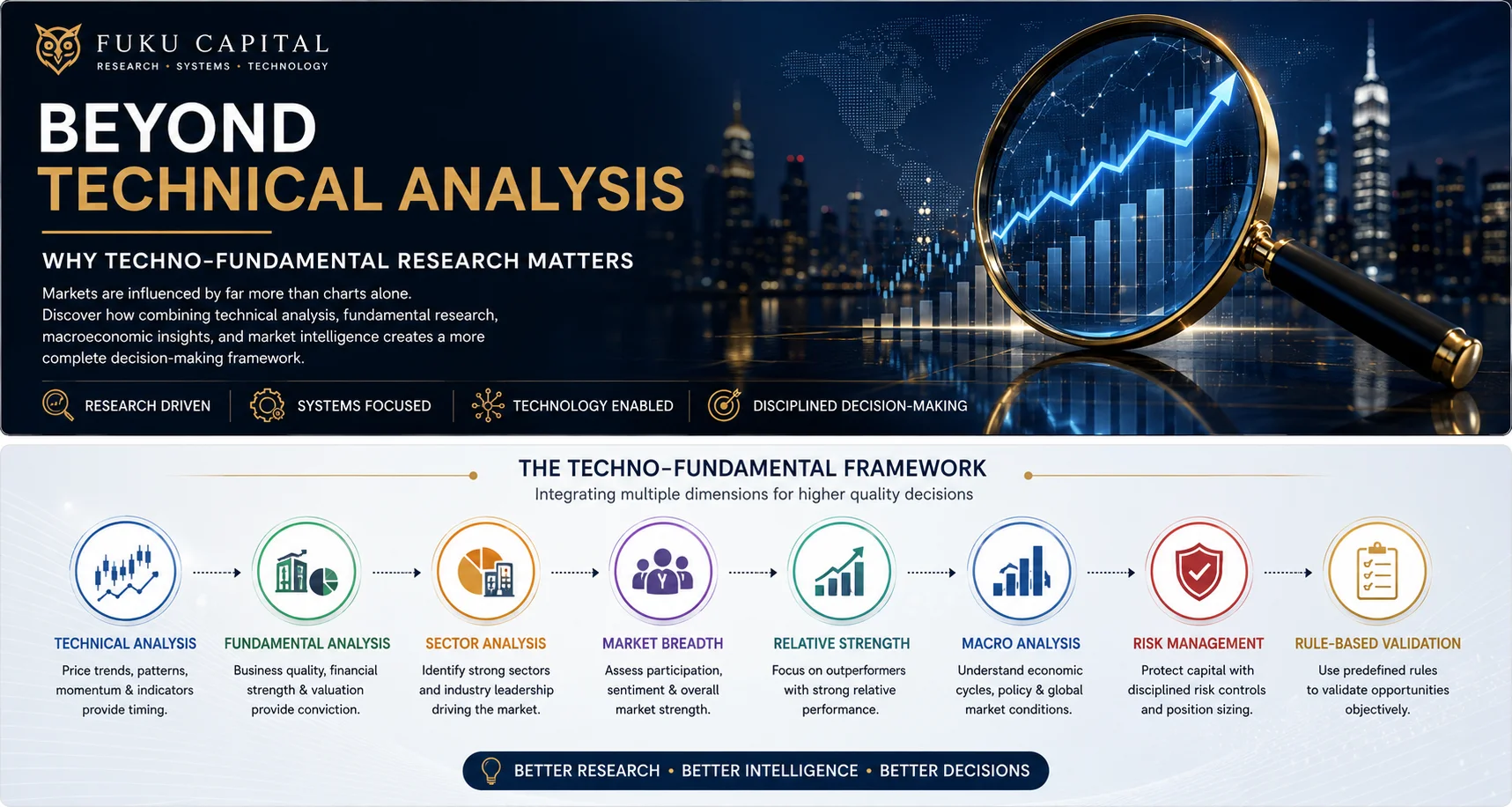
At Fuku Capital, we define techno-fundamental research as the integration of multiple analytical disciplines into a structured decision-making framework.
It combines:
- Technical Analysis
- Fundamental Analysis
- Sector Analysis
- Market Breadth
- Relative Strength
- Price & Volume Behaviour
- Macro-Economic Analysis
- Risk Management
- Rule-Based Validation
Each component strengthens the overall quality of analysis.
Building Conviction Through Multiple Confirmations
Rather than relying on a single signal, structured research looks for confirmation across multiple dimensions.
For example:
- Is the broader market supportive?
- Is the sector outperforming?
- Does price confirm the trend?
- Is volume supporting the move?
- Are macro conditions favourable?
- Does the opportunity satisfy predefined rules?
When several independent factors align, decision quality improves.
The Role of Technology
Modern financial markets generate enormous amounts of information.
Technology enables market participants to organize, filter, and interpret this information efficiently.
Examples include:
- Market scanners
- Rule-based dashboards
- Sector rotation analysis
- Relative strength rankings
- Screening frameworks
- Automated watchlists
- Decision-support systems
Technology allows research to become more systematic and repeatable.
Why Structured Frameworks Matter
Frameworks reduce emotional decision-making.
Instead of reacting to headlines or short-term volatility, they encourage consistent evaluation based on predefined criteria.
A disciplined framework helps market participants:
- Improve consistency
- Reduce bias
- Enhance risk awareness
- Increase analytical confidence
- Continuously refine their process
The Fuku Capital Philosophy
We believe better decisions are rarely the result of a single indicator.
They emerge through:
Research → Analysis → Frameworks → Systems → Intelligence → Decision
Our objective is not to predict every market movement.
Our objective is to build research-driven systems that simplify complexity and support informed decision-making.
Looking Ahead
As markets become increasingly interconnected, the ability to combine technical, fundamental, macroeconomic, and technological insights will become a significant competitive advantage.
The future belongs to those who can transform information into intelligence and intelligence into disciplined action.
Final Thoughts
Markets are constantly changing.
Processes should continuously evolve.
Research should never stop.
Technology should continuously improve.
Above all, disciplined decision-making should remain constant.
Key Takeaways
✔ Technical analysis provides timing.
✔ Fundamental analysis provides conviction.
✔ Macro analysis provides context.
✔ Technology improves efficiency.
✔ Structured frameworks improve consistency.
✔ Better decisions begin with better research.